
Per square metre and per job
Pressure Washing Cost in Melbourne
Pressure washing prices in Melbourne for plain concrete generally land between $3 and $6 a square metre, a call-out floor of about $180 applies to the smallest jobs, and commercial sites are priced individually after an inspection. This page gives owners and property managers realistic guide figures for driveways, paving, car parks and walls, walks through the factors that raise or lower a quote, and shows how wash water recovery affects the cost. Every job is confirmed at a fixed price before any work starts. For our regular cleaning rates, see the full Melbourne cleaning price guide.
Guide prices
What are typical pressure washing prices in Melbourne?
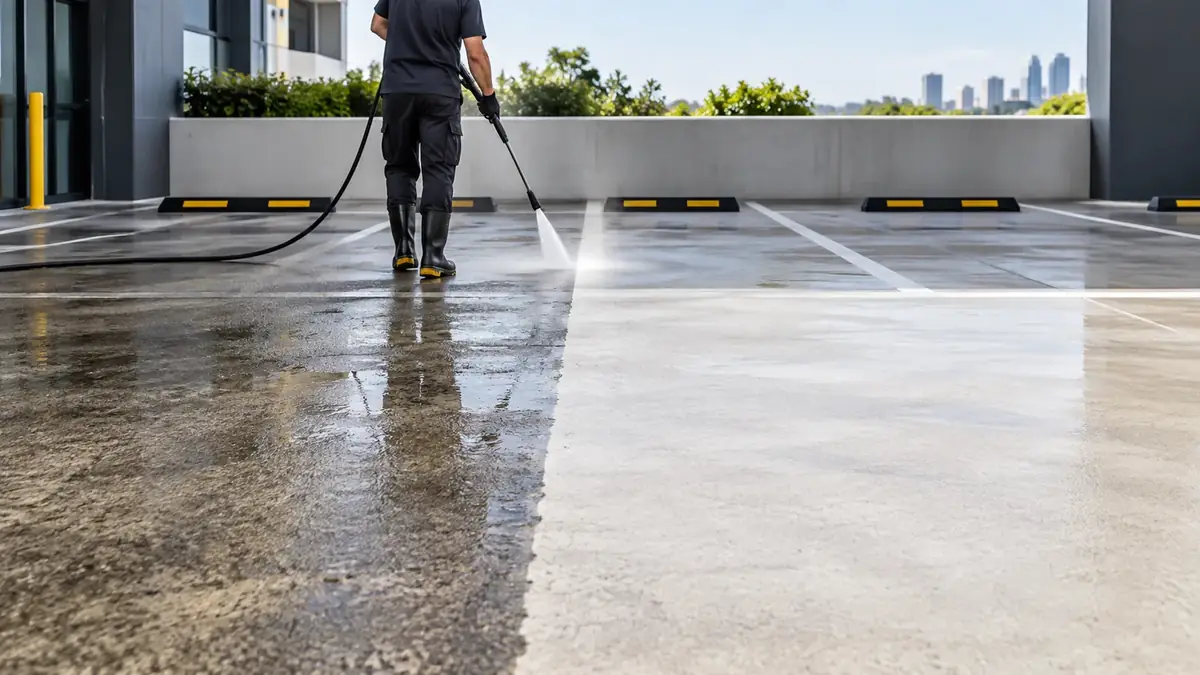
Typical pressure washing prices in Melbourne put concrete at roughly $3 to $6 a square metre, $4 to $8 per square metre for pavers, $180 to $350 for a standard home driveway and $150 to $350 for a soft-washed wall. Commercial car parks and loading docks are quoted per job.
These are typical Melbourne market figures for 2026, given as a guide rather than a price list. Your price is fixed after we see photos or the site, and it holds on the day unless extra areas are added.
Per square metre pricing works well for simple, open surfaces where the main variable is size. Per job pricing suits driveways, walls and small areas where set-up time, travel and edges take as long as the washing itself. That is also why a minimum charge exists, and why it pays to bundle areas: bringing a hot water unit, hoses, surface cleaner and drain protection to a site takes the same effort whether the area is ten square metres or forty.
Large commercial areas often come in at or below the low end per square metre, because the crew spends most of its time on open ground with a surface cleaner rather than on corners and set-up. That advantage can disappear if the site needs night work, traffic control or full wash water recovery, which is why those jobs are always inspected first.
What changes the price
What makes a pressure washing charge go up or down?
A pressure washing charge goes up with heavy staining, delicate or awkward surfaces, difficult access, out-of-hours timing and the need to recover dirty water. It goes down with larger open areas, easy access to water and power, and regular cleaning that stops grime from setting in the first place.
Stains are the biggest variable. A driveway that only needs a clean of dust and leaves is quick. The same driveway with years of oil drips, moss in the shady half and rust marks from a pot plant needs pre-treatment, dwell time and a second pass. Each of those adds minutes, and on a large site they add hours.
Wash water recovery is the next. A dusty footpath needs little more than care around the kerb drain. An oily loading dock or a workshop apron needs drain covers, temporary bunds, a recovery vacuum and disposal of the collected water. That is not optional: EPA Victoria fined a Melbourne developer almost $4,000 in 2025 after pressure cleaning a new driveway sent contaminated water into stormwater drains leading to the Werribee River. A quote that ignores recovery on a dirty site is cheaper only until something goes wrong.
Access and timing close the list. Steep driveways, narrow side paths, second-storey balconies and sites with no tap or power point take longer. Work at night or on weekends to avoid customers, tenants or deliveries costs more because of award penalty rates. If your schedule is flexible, say so; it often saves money.
Budgeting
Is regular pressure washing cheaper over a year?
For busy commercial sites, usually yes. A car park, dock or forecourt washed two to four times a year takes less time on each visit than one left for several years, because oil, gum and growth never get a chance to soak in. The yearly total is often similar or lower, and the site looks better throughout.
Neglected surfaces cost more in two ways. The first clean after a long gap needs heavier pre-treatment, slower passes and sometimes a second visit to lift what the first one loosened. And some stains become permanent if left long enough, which means the money spent never quite brings the surface back. A planned cycle avoids both.
The right frequency depends on use. A shopping strip forecourt with cafes and heavy foot traffic may need a wash every quarter. A business park car park may be fine with two a year, timed for before winter and before the end-of-year trading period. A residential driveway is usually fine with one every year or two. We suggest a cycle when we quote, and you can change it at any time.
If you manage several sites, grouping them into the same week or the same visit where they are close together reduces travel and set-up time, and that saving is passed on in the per-site price.
Timing within the year can help too. Autumn and the weeks before Christmas are the busiest periods for pressure washing in Melbourne, as owners prepare for winter and for the holiday trading rush. Booking outside those peaks usually gives you more choice of dates, and for large sites it is easier to schedule the night or weekend windows you need.
Book
How do you get a fixed pressure washing quote?
Send the address, the areas to be washed with rough measurements, and photos of the surface and any stains through the contact form. Small residential jobs can often be priced from photos; commercial sites get a short inspection. You receive a fixed price and a proposed date.
Methods, runoff handling and what can be washed safely are covered on our main page for pressure washing in Melbourne.
Questions
What do people ask about pressure washing costs?
The two most common cost questions are whether we charge by the square metre and whether there is a minimum charge. Both are answered below.