
Top to bottom, once
Deep Cleaning Services in Melbourne for One-Off Commercial Cleans
Our deep cleaning services in Melbourne are for business premises that need more than a nightly tidy: a reopening, a pre-inspection clean, a site that has slipped, or a new cleaning program that should start from zero. We clean the places regular visits skip, from vents and skirting to the grime under kitchen equipment, and hand you a written record when we finish. This is one of the one-off options within our range of commercial cleaning services.
Timing
When do deep cleaning services make sense?
Deep cleaning services make sense when a regular clean no longer gets a site back to standard, or when a single moment needs the building at its best: an audit, a sale, a reopening, a new tenant or the first day of a new cleaning program.
A deep clean is not a punishment for a bad cleaner. Every building collects dirt in places a regular visit is not designed to reach, because those visits are timed for the daily jobs. Once or twice a year, those places need their turn.
If your site shows three or more of the signs above, a regular program alone will not catch up, however many nights you book. Reset it first, then maintain it.
Events are the other common trigger. After a product launch, an end of year party or a weekend conference in your boardroom, the damage is concentrated: spilled drinks in carpet, sticky tables, overflowing bins in odd corners and a kitchen that has done a week's work in one night. A one-off clean the morning after puts it right before Monday.
Sale and lease moments count too. A buyer or incoming tenant notices dust on window frames and stained grout long before they notice the floor plan. A deep clean before an open inspection costs far less than the discount a tired building invites.
Scope
What does a commercial deep clean cover?
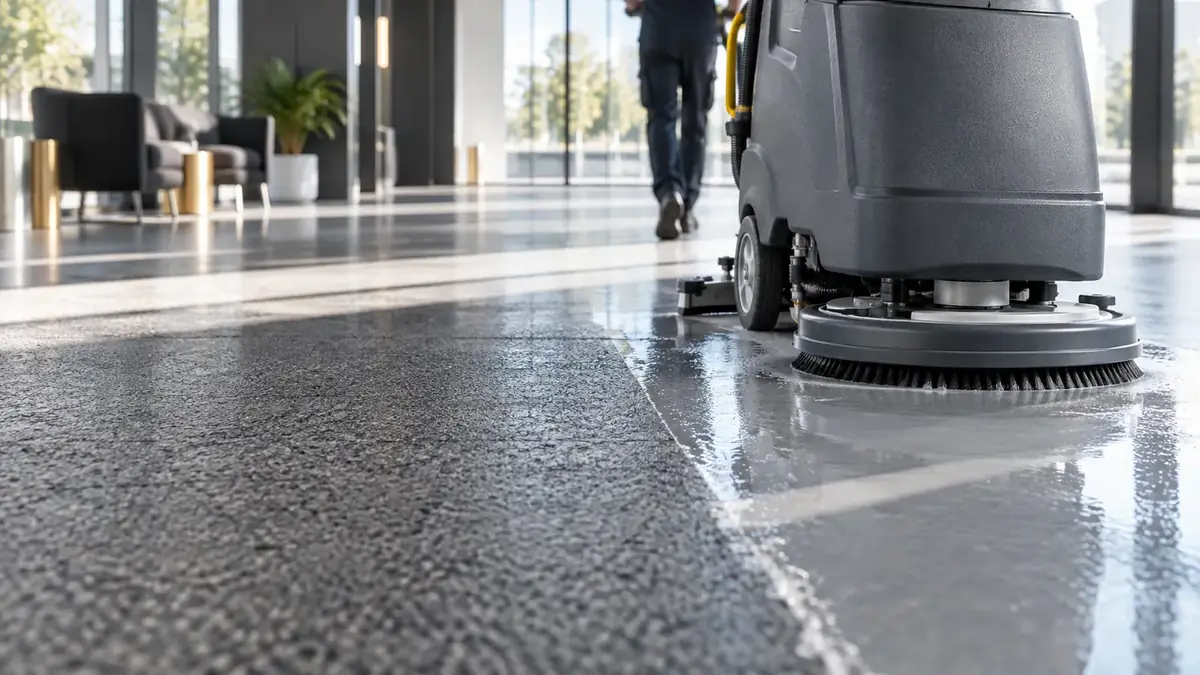
A commercial deep clean covers everything a regular visit does plus the surfaces it skips: high dusting, vents, skirting and doors, behind and under furniture and appliances, grout and hard floors scrubbed by machine, and kitchens degreased. Each item is listed in the scope before we start.
| Area or task | Regular visit | Deep clean |
|---|---|---|
| Bins, benches, basins, toilets | Every visit | Yes, in full detail |
| High dusting, vents, light fittings | Rotated monthly, if at all | Every one, with a ladder |
| Behind and under fridges, desks, cabinets | Not included | Moved and cleaned beneath |
| Walls, doors, switches, skirting | Spot marks only | Washed down where the finish allows |
| Hard floors and grout | Mopped | Machine scrubbed, grout brushed |
| Kitchen appliances inside | Microwave weekly | Fridge, oven, microwave, dishwasher filter |
| Window sills, tracks, blinds | Sills wiped | Tracks vacuumed, blinds dusted |
Some things sit outside a deep clean and are priced as separate items, because they need other machines: carpet hot water extraction, external glass above ground floor, kitchen exhaust canopies and pressure washing outside. We will say at the walk-through if your site needs any of them, and you can add them to the same visit.
When we finish, you get a written record listing each area, what was done and anything we found, such as a cracked tile, a mouldy seal or a blocked floor drain. It is the same document you would show a landlord or auditor.
Sequence counts for as much as the checklist does. We start high and finish low, so dust from light fittings and vents lands on surfaces we have not cleaned yet. Dry work comes before wet: vacuuming before mopping, dusting before wiping. Kitchens and bathrooms get their chemicals applied early so products have time to work while the crew moves through other rooms. Floors are last, room by room, working back towards the door so nobody walks across a clean surface.
Furniture that is moved is photographed first and put back where it was. Staff desks are not searched or rearranged; if a desk is covered in papers, we clean around it and note it on the record rather than touch anyone's work.
Surfaces are checked before any product touches them. Stone benchtops, timber veneers, powder-coated metal and older vinyl floors each react badly to the wrong chemical, so we test in a hidden spot first and use the gentlest product that will shift the grime.
Fit-outs
Do you deep clean after fit-outs and renovations?
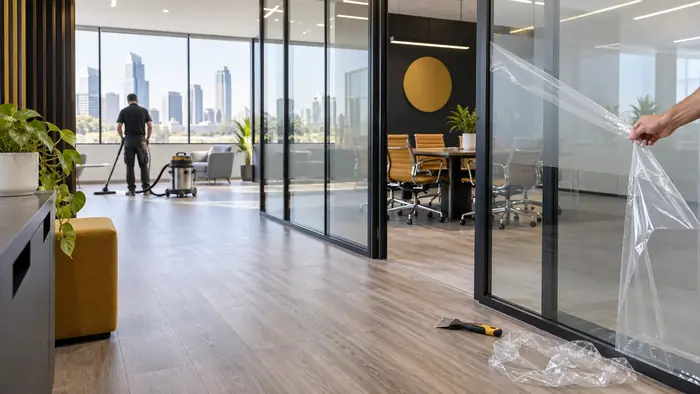
Yes. After a fit-out or renovation we remove the fine dust that settles on every surface, clean joinery inside and out, wipe down new fixtures and scrub the floors. Larger construction jobs, with debris and protective film still in place, are handled as a builders clean.
Renovation dust is different from everyday dust. Plasterboard and timber sanding leave a fine powder that drifts into drawers, rides the air conditioning and keeps landing for days. A single wipe looks fine at 5pm and dull again by morning.
For that reason we often book two visits: one straight after the trades leave, and a lighter one a few days later once the air has settled and the ducts have run. We also replace vacuum filters between the two, so dust is captured rather than blown around again.
If the builder is still finishing items, tell us which rooms are complete. We clean those first and come back for the rest, rather than cleaning around a tradesperson who will make it dusty again. For bigger projects, our page on post-construction builders cleans explains the staged approach.
Ask your builder or facility manager to change the air conditioning filters after the final clean, not before. Otherwise the first time the system runs at full speed, it pushes renovation dust back out of the ducts and onto everything we have just cleaned.
Starting fresh
Why book a deep clean before a regular program?
Because a regular program is designed to maintain a clean building, not to recover a dirty one. Starting with a deep clean means the nightly crew spends its hours on upkeep, standards hold from week one, and the regular price can stay lower.
- BeforeMonths of build-upGrey grout, sticky kitchen floors, dust on every high surface. A new nightly crew would spend weeks chipping away at it and still fall short.
- The resetOne deep cleanEvery area brought back to a known standard in a day or a weekend, recorded room by room so everyone agrees on the starting point.
- AfterRegular upkeepThe nightly checklist keeps that standard. Periodic tasks rotate through, and a spring clean each year stops it drifting again.
The written record from the deep clean becomes the baseline for your regular cleaning program. If standards slip later, we compare against it rather than arguing about what the office used to look like. After the first year, most clients swap the deep clean for a planned commercial spring clean, which is shorter because the building never falls as far behind.
This is also the fairest way to judge a new cleaner. Without a reset, the first month of any new program is spent catching up, and it is hard to tell whether the crew is slow or the site was simply dirty. With a clean baseline on paper, you can judge the regular service on its own merits from the first week.
Businesses with several sites can stagger the resets. We deep clean one location a weekend, start its regular program the following Monday, and move to the next site. Each location then begins its program from the same documented standard, which makes it much easier for an area manager to compare them later and spot the one that is slipping.
Quote
How is a one-off deep clean quoted?
A one-off deep clean is quoted as a fixed price after we see the site. The price depends on floor area, how many kitchens and bathrooms there are, how far the site has slipped and whether it must be done out of hours or over a weekend.
Our guide to commercial cleaning prices gives typical ranges. For an exact figure, request a walk-through and tell us any deadline, such as an inspection date, so we can book the crew around it. The Cleaning Services Award sets minimum pay and weekend penalty rates for cleaners, which is why a Saturday deep clean costs more than a Tuesday one.
On the day, we need access for the full booked window, somewhere to park a van close to an entry, and a contact who can answer questions if we find something unexpected. Clear personal items from desks the day before and the job moves faster.
Questions
What should you know before booking a deep clean?
People booking a deep clean usually want to know three things: how long it will take, whether it can happen when the building is empty, and what happens if something on the list is missed. Here are the straight answers, with the detail for your site confirmed at the walk-through.