
Guide · 10 minute read · Checked October 2026
A Guide to Commercial Carpet Cleaning
This guide to commercial carpet cleaning explains the methods professionals use, how often each part of a floor needs attention, how long carpet takes to dry, and how to put together a maintenance program that makes carpet last. It is written for office managers, facility managers and business owners who look after carpet but are not carpet specialists, and who want to judge a quote or a cleaner's advice with some confidence. The short version: vacuum often, deal with spills fast, clean the busy lanes more often than the quiet corners, and book a deep extraction clean at least once a year on most commercial floors. The detail below explains why. More practical guides are listed on our commercial cleaning guides page.
Know your carpet
Why does the type of carpet matter before any commercial carpet cleaning?
Carpet type matters because fibres react differently to heat, moisture and chemicals. Nylon handles hot water extraction well, wool needs gentler, wool-safe products, polypropylene resists stains but holds oily soil, and solution-dyed fibres tolerate stronger spot treatments. Checking the fibre first avoids damage and warranty problems.
- NylonMost commonHard-wearing and resilient. Takes extraction well; unprotected nylon can stain from strong dyes.
- Wool and wool blendsHandle with careNaturally soil-resistant but sensitive to high alkalinity and heat. Needs wool-safe products.
- PolypropyleneBudget and outdoorResists water-based stains, attracts oily soil, and can crush in busy lanes.
- Solution-dyedColour right throughColour is part of the fibre, so it resists bleaching and tolerates stronger spot treatment.
Most offices have nylon carpet tiles, often solution-dyed, because they are durable, easy to replace one tile at a time and forgiving to clean. Boardrooms, hotels and older buildings sometimes have wool or wool-blend broadloom, which looks and feels better but needs more careful cleaning. If you are not sure what you have, the fit-out documents or the building manager usually know, and a good carpet cleaner will check before starting.
Construction matters too. Cut pile hides dirt well but shows traffic crushing. Loop pile is tough but can snag if a machine brush catches it. Modular tiles on a stiff backing give up moisture sooner than broadloom stretched over underlay. All of this affects which method suits your floor and how long it will be out of use.
Warranties are worth a look. Many carpet manufacturers tie their warranties to regular maintenance, usually following the Australian and New Zealand carpet cleaning standard, AS/NZS 3733. Keeping a simple record of when the carpet was cleaned and by what method can save an argument if you ever need to make a claim.
Methods compared
What are the main commercial carpet cleaning methods?
The main methods are vacuuming, spot cleaning, interim low-moisture cleaning and restorative hot water extraction. Each has a job. Vacuuming removes loose grit daily, spotting deals with spills, interim cleaning keeps traffic lanes presentable, and extraction removes the deep soil and residue that the others leave behind.
Vacuuming is by far the most important. Most of the soil in carpet is dry grit walked in from outside, and grit is abrasive. Every footstep grinds it against the fibres, which is what wears traffic lanes dull and fuzzy. A good upright or backpack vacuum with a beater bar, used often, removes most of it before it does damage. No deep clean can make up for a floor that is rarely vacuumed.
Spot cleaning is the second line. The sooner a spill is blotted and treated, the less likely it is to become a permanent stain. Blot rather than rub, work from the outside of the spot in, and use a cleaner suited to the spill. Coffee and tea need a different approach from grease or ink. Some businesses keep a basic spotting kit on site so staff can deal with small spills straight away.
Interim cleaning uses very little water. Encapsulation and bonnet methods apply a cleaning solution with a machine, which either dries to a powder that is vacuumed up or is absorbed into a pad. They are quick, the floor is usable within an hour or so, and they keep busy areas looking good between deep cleans. What they do not do is flush out deep soil and old detergent residue.
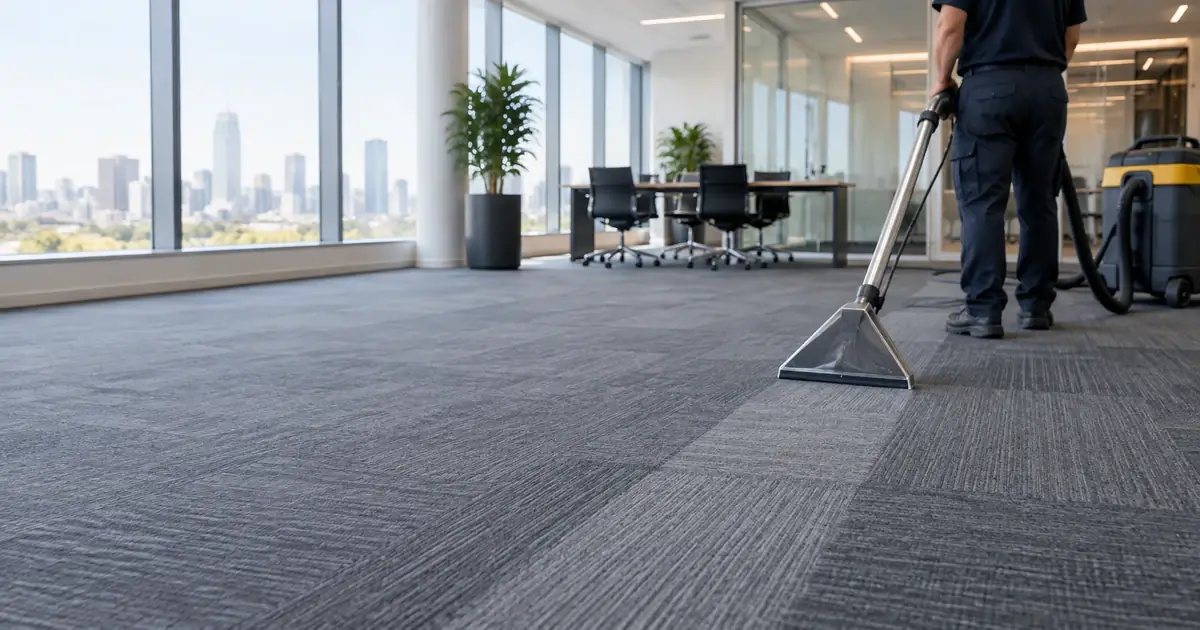
Restorative cleaning, usually hot water extraction, does. The machine injects heated rinse water through the pile and recovers it in the same pass, and the soil leaves with the water. It is the method the Carpet Institute of Australia describes as the most common corrective clean. It takes longer to dry, so it is scheduled when the floor can be left alone for several hours.
Whichever method is used, the pre-treatment matters. A pre-spray applied to the traffic lanes and left for a few minutes breaks down oily soil so the extraction or interim clean can lift it. Skipping it is one of the main reasons a freshly cleaned carpet still looks grey in the walkways. It is also worth asking what rinse the cleaner uses, since a neutral or slightly acidic rinse leaves carpet softer and less prone to re-soiling.
Dry compound or powder methods also exist and can suit carpet that must not get wet, such as some older installations. They are less common in Australian commercial cleaning but worth knowing about if your carpet has special requirements.
How often, by traffic
How often should office carpet be cleaned?
Office carpet should be vacuumed daily in busy areas and two to four times a week elsewhere, spot cleaned as spills happen, interim cleaned every three to nine months, and deep cleaned every six to eighteen months. Busier floors sit at the frequent end of each range.
- VacuumingRemoves grit before it grinds the fibres. Entries and walkways need it most.Daily to 2 to 4 times a week
- Spot cleaningBlot and treat spills before they set into stains.As spills happen
- Interim cleanLow-moisture cleaning of lanes and entries between deep cleans.Every 3 to 9 months
- Deep cleanHot water extraction to remove deep soil and residue.Every 6 to 18 months
These ranges come from the Carpet Institute of Australia's guidance on commercial carpet maintenance, which is based on the AS/NZS 3733:2018 standard. The Institute also stresses entry matting: most soil comes in from outside, so walk-off mats at every external door, long enough to catch several footsteps, protect the rest of the floor more than any cleaning schedule.
Think in zones rather than whole floors. The first few metres inside the entry, the path from the lift to the kitchen and the area around the printer may need attention four times as often as a quiet corner office. Cleaning the whole floor on the schedule of its busiest part wastes money; cleaning it all on the schedule of its quietest part ruins the lanes.
Melbourne weather plays a part too. Wet winters bring more water and grit through the door, and the months after winter are a good time for an interim or deep clean of entries and walkways.
Drying and reopening
How long does commercial carpet take to dry?
After hot water extraction, commercial carpet usually takes somewhere between two and eight hours to dry, depending on the carpet, the weather and the airflow. Low-moisture interim cleans are usually walkable within about an hour. Air movers and running ventilation shorten drying times considerably.
Drying time is where the method decision often gets made. If staff arrive at 7 am and the crew cannot start until 10 pm, an extraction clean on thick broadloom in a cold building is risky. The same clean on carpet tiles, with air movers and the air-conditioning left on, is usually dry well before morning.
Damp carpet is not just an inconvenience. Walking on it too early pulls soil back into the fibres. Furniture put back too soon can leave rust or dye marks. And carpet that stays wet for a long time can develop a musty smell. A good cleaner measures the moisture going in, uses fast-drying techniques and tells you honestly how long to keep people off.
Simple steps help. Clear the floor of bins and chairs before the crew arrives, ask building management to leave ventilation running overnight, and avoid scheduling an extraction clean for the night before a big event.
Programs
What does a good carpet maintenance program look like?
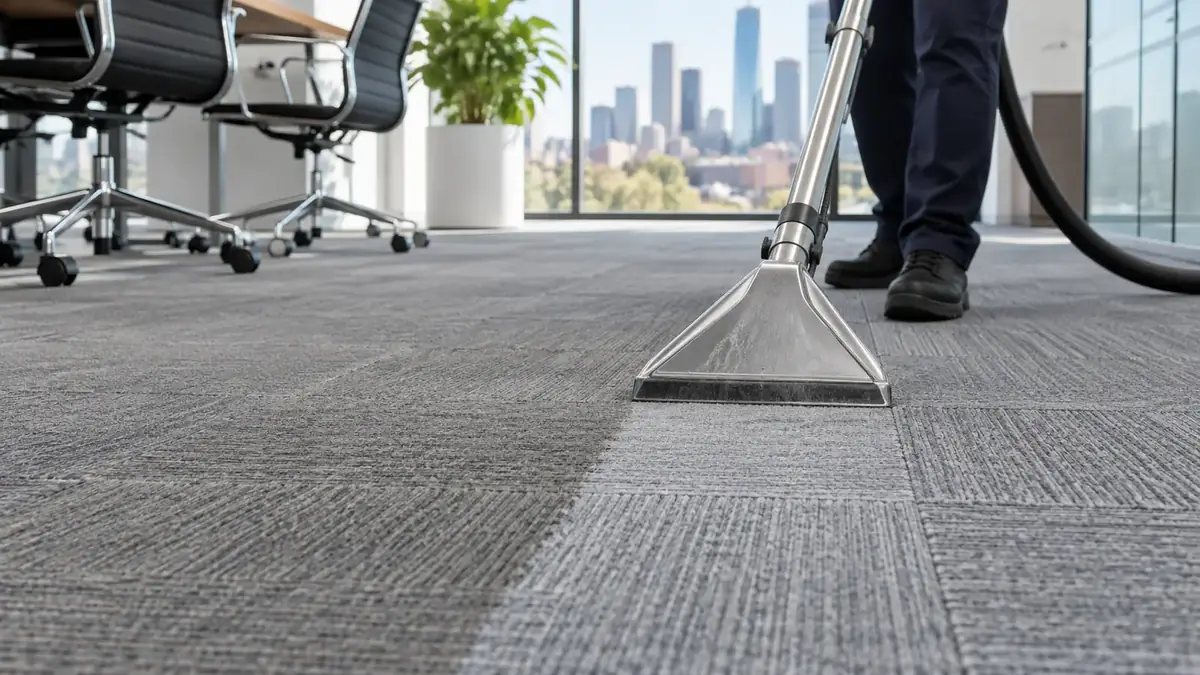
A good carpet maintenance program is written down, zoned by traffic and spread across the year. It names who vacuums and how often, what the spotting procedure is, when each zone gets an interim clean, and when the whole floor is deep cleaned, with a record kept of each visit.
Most businesses already do part of this without calling it a program. The nightly cleaner vacuums; someone deals with coffee spills; the carpet gets steam cleaned when it looks bad or when the lease ends. The difference with a proper program is timing. Cleaning on a schedule before the carpet looks bad means the fibres never get badly worn, and the carpet lasts years longer before replacement.
A simple program for a typical office might be: daily vacuuming of walkways and entries, vacuuming of offices two or three times a week, spotting as needed, a low-moisture pass over the lanes each quarter or so, and one complete extraction every year, ideally across a long weekend. Busier sites tighten each step; quieter ones loosen them.
When you compare providers, ask them to describe the program they would set up rather than just a price for a one-off clean. If you would like us to look at your floor and suggest one, our commercial carpet cleaning service in Melbourne covers inspections, methods and scheduling.
Questions
What else do people ask about carpet care?
The questions below come up whenever carpet care is discussed with office and facility managers. Short, direct answers follow.